Adso of Melk
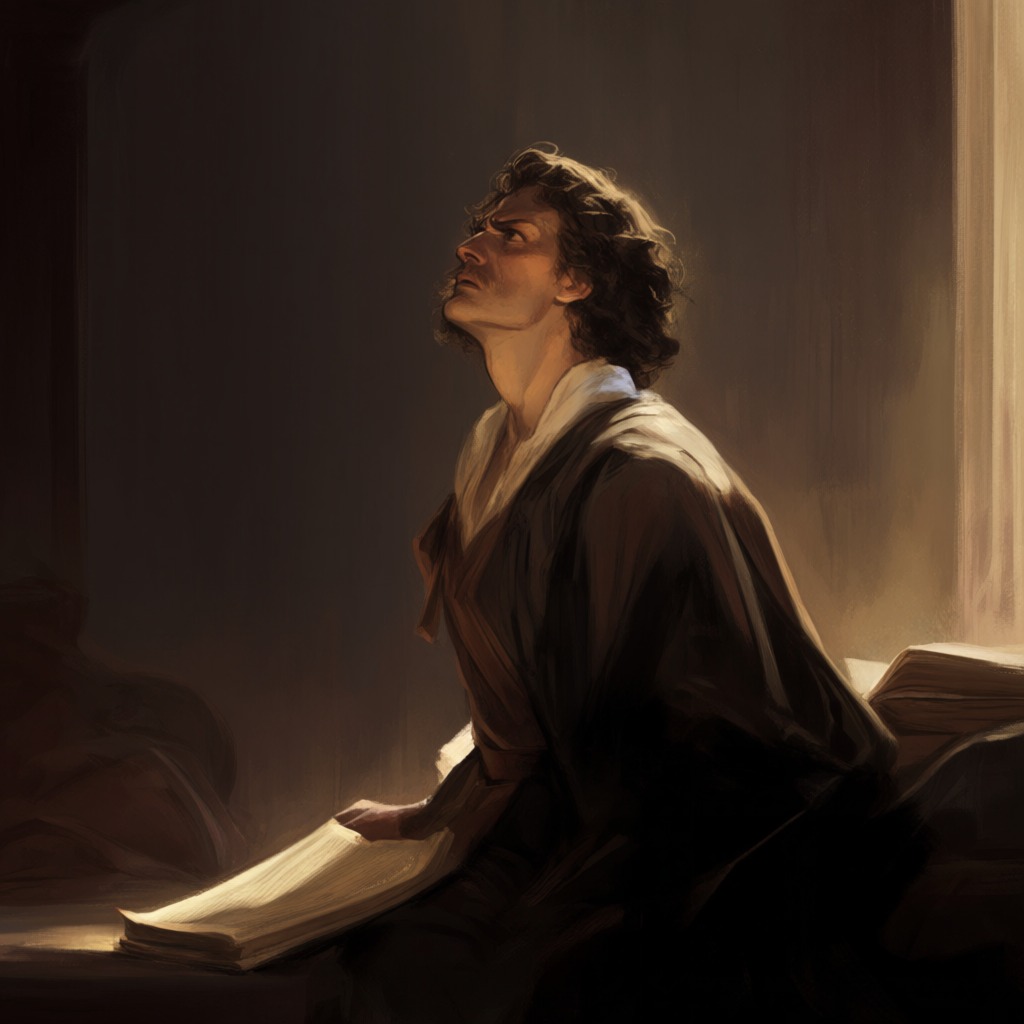
Adso of Melk is the elderly Benedictine novice who narrates the entire novel as a memoir written in his old age, recounting the seven days he spent in a wealthy Italian abbey in November 1327 as the young scribe and disciple of the Franciscan friar William of Baskerville. His first-person account, framed by a preface describing the manuscript's discovery, transforms a series of murders into a meditation on truth, doubt, and the limits of human knowledge.
Identity and Background
Adso is a young Benedictine novice from the monastery of Melk, the son of a baron fighting in the train of Emperor Louis the Bavarian. His father, thinking it wise for him to see the wonders of Italy and be present at the Emperor's coronation in Rome, took him along on the campaign. Left to himself during the siege of Pisa, Adso roamed the Tuscan cities out of idleness and a desire to learn. On the advice of Marsilius of Padua, who had taken a liking to him, his parents decided to place him under the direction of the learned Franciscan Brother William of Baskerville, who was about to undertake a mission to famous cities and ancient abbeys. Thus Adso became William's scribe and disciple, a role he never regretted, because with him he was witness to events worthy of being handed down to those who would come after. He describes himself as having been a boy at the time, and his narrative is written when he is old, his hair white, confined in his cell at Melk, preparing to leave on parchment his testimony of the wondrous and terrible events he observed in his youth.
Life and Plot Trajectory
Adso's journey with William takes them to a wealthy abbey in northern Italy, where they arrive at the end of November 1327. The abbot, Abo, asks William to investigate the death of a young illuminator, Adelmo of Otranto, whose body was found at the foot of the cliff below the Aedificium. As more monks die—Venantius of Salvemec found in a jar of pigs' blood, Berengar of Arundel drowned in a bath, Severinus of Sankt Wendel bludgeoned with an armillary sphere, and Malachi of Hildesheim poisoned during matins—Adso accompanies William through the abbey, questioning monks, exploring the labyrinthine library, and deciphering clues. He witnesses the arrival of papal and imperial legations, the trial of the cellarer Remigio of Varagine for heresy, and the capture of the peasant girl with whom he had a sexual encounter. On the seventh night, he follows William into the secret room called the finis Africae, where they confront the blind librarian Jorge of Burgos, who has been poisoning the forbidden book—Aristotle's lost second book of the Poetics—and who sets the library ablaze, destroying the greatest library in Christendom. Adso and William escape the burning abbey, and Adso later returns to Melk, where he writes his account.
Key Actions and Objectives
Adso's primary role is that of observer and recorder. He is the one who copies down the zodiacal signs from Venantius's parchment, who steals a lamp from the kitchen for their nocturnal explorations, and who accidentally discovers the key to entering the finis Africae when he misinterprets Salvatore's Latin phrase "tertius equi" as referring to the letter 'u' in the word "equus," leading William to realize that "primum et septimum de quatuor" refers to the letters of the word "quatuor" in the verse "Super thronos viginti quatuor." He also has a significant personal experience: a sexual encounter with a peasant girl in the kitchen, which he later confesses to William and which fills him with both guilt and a profound, troubling sense of beauty. This encounter, along with his reading of the Speculum amoris by Maximus of Bologna in the library, plunges him into the torments of lovesickness, which he analyzes at length through the lens of medieval medical and theological texts.
Relationships and Conflict
Adso's central relationship is with his master, William of Baskerville, whom he admires deeply but whose skeptical, questioning approach to truth often puzzles him. He is also influenced by the mystic Ubertino of Casale, who warns him about the dangers of female beauty and tells him the story of Fra Dolcino. He is frightened by the blind librarian Jorge of Burgos, whose apocalyptic sermons terrify him, and he is drawn into a web of conflicting loyalties as he observes the monks' rivalries and the political machinations of the papal and imperial legations. His encounter with the peasant girl creates an internal conflict between his monastic vows and his natural desires, a conflict he never fully resolves.
Change and Ending
Adso's journey through the abbey is a loss of innocence. He begins as a naive novice who believes in a world of clear truths and divine order, but he is confronted with murder, heresy, lust, and the destruction of the library. William's final words—that there is no order in the universe, that the only truth is learning to free oneself from the insane passion for truth—leave Adso in a state of profound uncertainty. In his old age, writing the manuscript, he still does not know whether the story he has told contains any hidden meaning, or more than one, or many, or none at all. He ends his narrative with the Latin tag "Stat rosa pristina nomine, nomina nuda tenemus" (The rose of old exists only in its name; we possess only naked names), suggesting that all that remains of the abbey's glory and the events he witnessed is the story itself.
Narrative Role and Evaluation
Adso is the novel's narrator and focalizer; everything the reader knows is filtered through his consciousness. His voice, that of an old monk looking back on his youth, gives the story a tone of melancholy and distance. His naivety allows the reader to discover the abbey's mysteries alongside him, while his occasional insights—such as his dream of the Coena Cypriani, which William interprets as a key to the crimes—show that he is not merely a passive observer. His character embodies the novel's central themes: the tension between faith and reason, the seduction of knowledge, the nature of truth, and the difficulty of distinguishing good from evil. He is both a participant in the story and its ultimate interpreter, and his inability to find a final, stable meaning in the events he recounts reflects the novel's own epistemological skepticism.
In the 2019 television miniseries adaptation of the novel, the role of Adso was played by German actor Damian Hardung, who portrayed the young novice in his first major screen role. The series, directed by Giacomo Battiato, aired on Rai 1 in Italy and later on BBC Two in the UK, with Hardung's performance noted for capturing Adso's youthful curiosity and growing disillusionment as he witnesses the abbey's dark secrets unfold.